

Here’s something we tell clients all the time: a small garden is not a lesser garden. Some of the most striking projects we’ve ever completed are compact city gardens — spaces in Ranelagh, Portobello and Phibsborough where every square metre had to earn its place.
In fact, small gardens reward good design more than large ones. In a big garden, mistakes get absorbed. In a small garden, every decision shows — which is exactly why the best small gardens feel so considered, so complete, and so effortlessly luxurious.
If you have a compact garden and big ambitions for it, here are the ideas and principles we use to design small gardens that live far beyond their size.
1. Design It as One Room, Not a Collection of Features
The biggest mistake in small gardens is treating them as a checklist — a bit of paving here, a shed there, a planter in the corner. The result feels cluttered and smaller than it is.
The gardens that work are designed as a single, coherent outdoor room. One consistent palette of materials, a deliberate layout, and every element — seating, planting, lighting, boundaries — designed together. Our Portobello garden project is a perfect example: a compact space that functions as a true extension of the house because it was conceived as one design, not assembled piece by piece.
2. Built-In Seating Changes Everything
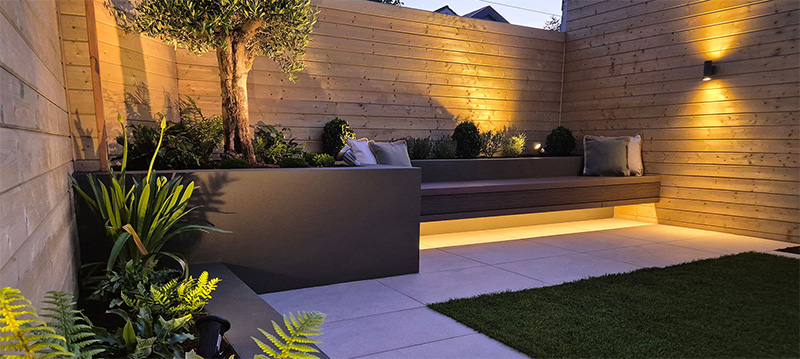
Freestanding furniture eats space. Built-in benches — floating timber or composite seating along a boundary wall, often with storage beneath — seat more people in less room, give the garden architectural character, and never need dragging in for winter. Add outdoor cushions and integrated lighting beneath the seat, and you have the kind of detail that makes a garden feel bespoke rather than bought.
3. Think Vertically
When floor space is limited, the walls are your garden. Slatted timber or composite cladding transforms tired boundary walls into a designed backdrop. Climbers and green walls soften hard surfaces. Raised planters at varying heights add depth and layers. In our Ranelagh garden, timber-clad boundaries with integrated planters and bench seating turned the walls themselves into the garden’s defining feature.
4. Invest in Fewer, Better Materials
This is where small gardens hold a genuine advantage: the space works in your favour. Large-format porcelain paving, quality hardwood or composite cladding, corten steel planters — materials that might stretch the budget across a large site become achievable when the area is compact. A small garden finished in premium materials feels like a boutique hotel courtyard. The same garden in budget materials just feels small.
5. Use Levels — Even Subtle Ones
A single step up to a raised dining terrace, a sunken seating area, planters at two or three heights — even modest level changes create a sense of journey and make a compact space feel composed and architectural. If your garden already slopes, better again: that’s structure waiting to be designed.
6. Light It Like You Mean It
Lighting is the single most transformative feature in a small garden — and the most overlooked. Uplit specimen trees, concealed strips beneath benches and steps, subtle wall washes on textured cladding. After dark, a well-lit small garden becomes a second living room you can enjoy from inside the house all year round — doubling the time you get from the space for a fraction of the cost of extending it. See how dramatic the difference can be in our gardens at night gallery.
7. One Statement, Not Five
A small garden can absolutely carry a luxury feature — a water feature, an outdoor fireplace, a striking specimen tree, even a compact outdoor kitchen. The discipline is choosing one and designing the garden around it. A single confident statement reads as luxury; several competing ones read as clutter.
8. Plant Generously, Not Sparsely
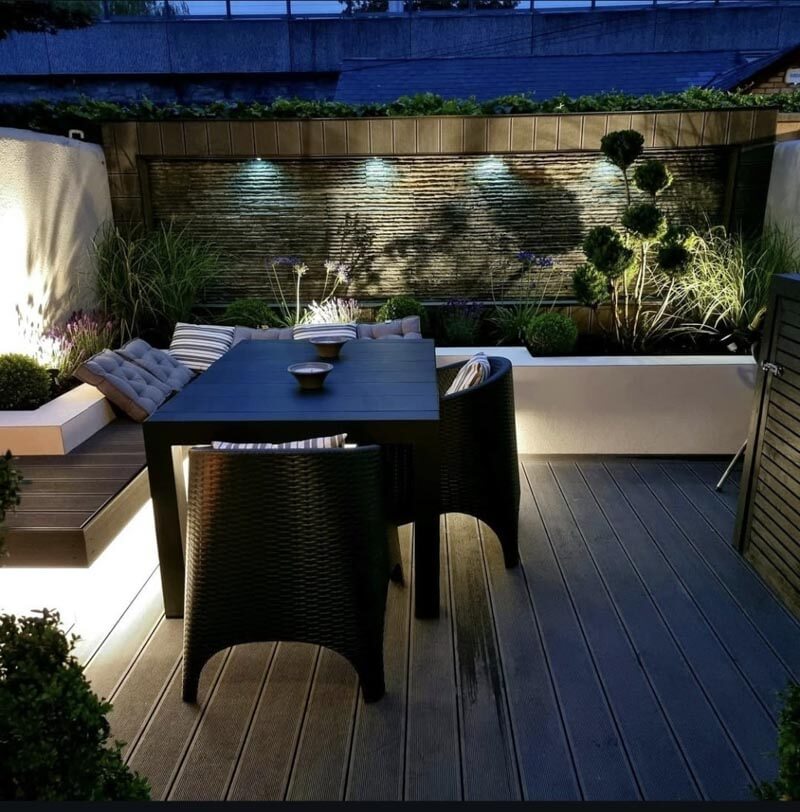
Counterintuitively, small gardens need bold planting. Mean little borders make a space feel apologetic. Layered, generous planting — a multi-stem specimen tree, architectural evergreens, soft textural underplanting — gives a compact garden depth, privacy and year-round life. This is where a proper planting and garden design service earns its keep.
What Does a Luxury Small Garden Cost?
Small doesn’t mean cheap — it means concentrated. A fully designed and built city garden with premium materials, built-in seating, lighting and planting typically starts from around €20,000–€35,000, with more ambitious compact gardens — level changes, outdoor kitchens, bespoke joinery — going beyond that. For honest detail on what different budgets deliver, see our 2026 Dublin Garden Renovation Cost Guide.
See What’s Possible in a Small Garden
The best way to understand what a compact garden can become is to look at real ones. Explore our city garden projects in Ranelagh, Portobello and Phibsborough — three very different small gardens, all designed to live large.
And if you’re ready to talk about your own, get in touch to arrange a consultation. We’ll walk the space with you, talk honestly about budget, and show you — with full 3D visuals — exactly what your small garden could be.